
A Strategic Tool for Human-AI Experience Design
The Challenge
Organizations struggle to design coherent experiences that work for both humans and AI systems. Most approaches focus on either user interfaces OR system optimization, missing the critical intersections between them.
The Solution: A 3×3 Navigator
The Experience Navigator (Nexus Matrix) maps experiences across 3 Roles and 3 Entities:
Roles (How you engage)
- User: Direct interactions and interfaces
- Enabler: Tools and infrastructure that empower
- Orchestrator: Coordination and integration across systems
Entities (Who’s involved)
- Beneficiary: Value recipients (customers, end-users)
- Collaborator: Active contributors (employees, partners)
- System: AI agents and autonomous technologies
The Nine Strategic Intersections

Implementation Strategy: The 3-Stage Sequence
Stage 1: Foundation (Months 1-2) Start with User intersections – direct human experiences must work before adding complexity.
Priority order:
- User × Beneficiary (customer interfaces)
- User × Collaborator (employee tools)
- User × System (human-AI interactions)
Stage 2: Empowerment (Months 3-4) Add Enabler intersections – tools that amplify human capabilities.
- Enabler × Collaborator (automation tools)
- Enabler × Beneficiary (self-service features)
- Enabler × System (system infrastructure)
Stage 3: Orchestration (Months 5-6) Complete with Orchestrator intersections – sophisticated coordination.
- Orchestrator × Beneficiary (journey orchestration)
- Orchestrator × Collaborator (workflow integration)
- Orchestrator × System (AI coordination)
Quick Start Method
Week 1-2: Rapid Validation
- Pick your highest-impact intersection (usually User × Beneficiary)
- Build a basic prototype
- Test with real users
- Measure engagement and feedback
Success criteria for continuing:
- 70%+ user engagement in first interaction
- Clear problem-solution fit
- Stakeholder enthusiasm maintained
Example: Transportation Management System
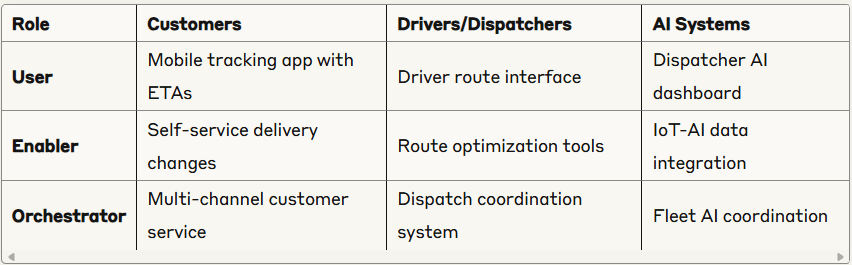
Implementation sequence: Start with customer tracking app, then driver tools, build toward full AI fleet coordination.
Key Principles
- Foundation First: Human experiences must work before AI complexity
- Inside-Out: Direct interactions → Empowerment tools → System coordination
- Measurable Value: Each stage delivers independent business results
- Conflict Aware: Use hierarchy – Beneficiary needs > Collaborator needs > System optimization
When to Use The Experience Navigator
Best fit:
- Complex systems with multiple user types
- Human-AI integration challenges
- Cross-functional teams needing alignment
- Organizations ready for systematic approach
Poor fit:
- Simple, single-user applications
- Organizations without basic design capabilities
- Highly regulated environments where compliance overrides experience
- Teams needing immediate quick wins over systematic improvement
Getting Started Checklist
Before implementing, ensure you have:
- User research and feedback capabilities
- Cross-functional collaboration processes
- Executive sponsorship for 6-month timeline
- Technical team with API/integration experience
- Clear success metrics for each intersection
Success Measurement
Track different metrics by intersection type:
- User intersections: Adoption rates, satisfaction scores, task completion
- Enabler intersections: Efficiency gains, error reduction, tool usage
- Orchestrator intersections: System uptime, integration success, coordination effectiveness
Common Pitfalls
- Jumping to complex AI coordination before basic user experiences work
- Treating all intersections as equally important
- Ignoring conflicts between intersection requirements
- Lacking clear success criteria for each stage
- Underestimating organizational change management needs
Credits
Framework Creator: Dhilip Narayan Srinivasan
Development Process: Created through collaborative refinement with AI systems including Grok (xAI) and Claude (Anthropic) for brainstorming, critical analysis, and articulation support.
This simple briefing guide presents the core methodology overview of The Experience Navigator (Experience Nexus Matrix). For detailed implementation guidance, conflict resolution techniques, and industry-specific templates – Connect with us.

Leave a comment