
Navigating AI’s Ostrich and Hammer-Nail Syndromes in Logistics (Transportation Management)
Introduction: AI Is Here, Now What?
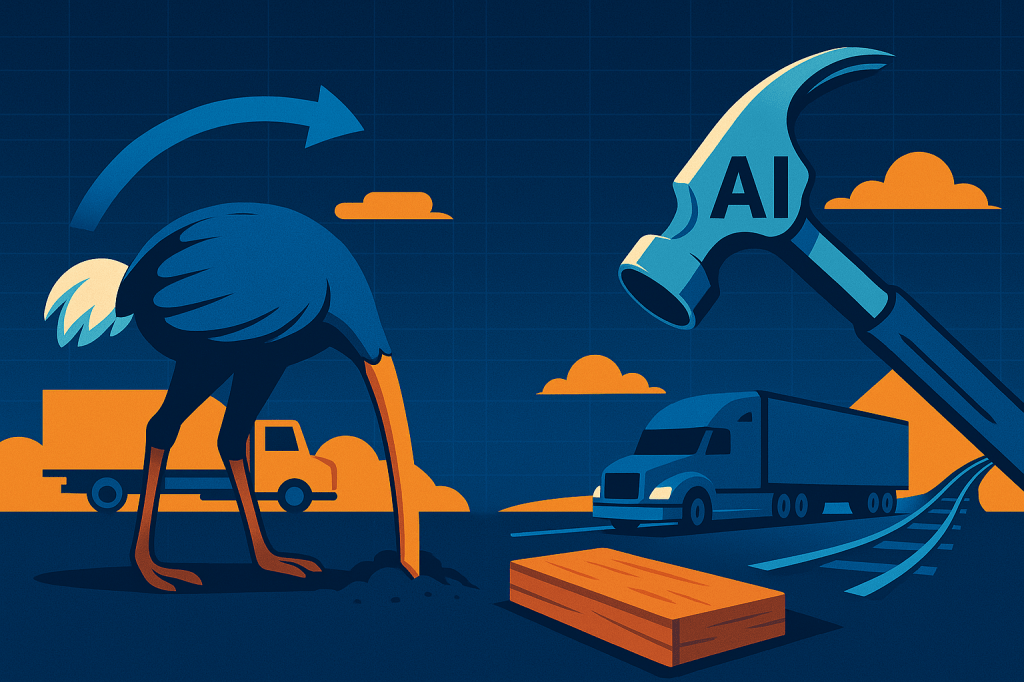
In 2025, Artificial Intelligence (AI) and Generative AI (Gen AI) are transforming logistics. From Amazon’s AI-optimized delivery routes to Maersk’s predictive freight analytics, AI has shifted from “what if” to “how to.” The question isn’t “Do we need AI?” but “How do we thrive with AI while preserving the human edge—creativity, strategy, and oversight?” Yet, shippers and TMS vendors often fall into two traps: the ostrich syndrome, ignoring AI’s potential, or the hammer-nail syndrome, misapplying AI to every problem. A strong foundation is key to harnessing AI effectively. Let’s explore how to avoid these extremes and unlock AI’s value in transportation management systems (TMS) and logistics.
The AI Boom: Where Are the Results?
AI adoption is surging—the writing is on the wall. Over 80% of companies now have AI initiatives, and ~66% use Gen AI.
In logistics, successes stand out:
- An American multi-national retailer boosts inventory efficiency by 15% with AI-driven demand forecasting.
- An Indian e-commerce major cuts delivery times by 20% using AI-driven last-mile optimization.
- A global TMS vendor optimizes freight allocation with AI, saving clients over 10% on transport costs.
- An American 3PL’s AI solution automates 2,000 daily LTL freight classifications, saving 300 hours weekly.
Yet, many firms suffer in silence. Only ~25% scale AI effectively, stalled by pilot traps, poor data, or misaligned strategies, data by analyst and consulting firms reveal that:
- ~66% of supply chain AI initiatives exceed budgets by ~50% due to underestimated complexity.
- 76% of organizations face master data issues undermining AI accuracy.
- Poor integration with existing TMS creates inefficiencies.
- High upfront and maintenance costs prove unsustainable.
While successes indicate AI can deliver upwards of 3.5x returns, most initiatives fail due to data issues, integration complexity, and cost overruns, not technology limitations. Companies underestimate the foundational work needed. AI isn’t a magic wand—despite the hype—but with the right groundwork, it’s the closest you’ll get. Like a high-powered TMS, AI needs clean data, clear goals, and strategic focus to deliver. Why do some logistics leaders soar while others stall?
Why the Divide?
The Ostrich and Hammer-Nail Traps
When your foundation—data, strategy, alignment—is weak, AI does more harm than good. The ostrich syndrome sees shippers and TMS vendors dismissing AI-driven capabilities like TMS forecasting as a fad, losing up to 15% market share to early adopters. Legacy TMS vendors ignoring AI risk obsolescence to AI-native competitors. Conversely, the hammer-nail syndrome drives overuse, like a 3PL wasting millions on Gen AI for basic shipment tracking—a task GPS could handle. Poor data—linked to ~3/4th of AI failures—amplifies these errors. Fear of redundancy looms: 2/3rd of logistics leaders worry AI will displace jobs, with 20% more agreeing discreetly. AI augments, not replaces, but robust foundations are critical for success.
FOMO (Fear of Missing Out)
and the Hammer-Nail Syndrome
FOMO fuels the hammer-nail syndrome. With a large majority of executives feel AI adoption pressure (according to leading analyst firms), shippers and TMS vendors rush in.

What’s costlier than no AI predictions? Wrong AI predictions.
What’s even worse? Doing it for wrong problems.
A dangerous mix of weak TMS foundation—fragmented data—unrepresented scenarios led a shipper (a large consumer goods corporation) to misapply AI for route optimization, increasing fuel costs by 8% due to inaccurate predictions.
Contrast this with a major shipping company’s AI-powered TMS, saving 100 million miles annually. Selective, high-impact integration is key. FOMO, amplified by peer pressure and analyst reports, blinds executives and their firms to problem-fit. Without clean data and integrated systems, AI becomes a costly misstep, not a logistics superpower. An Indian-rooted company’s ad said, “We build slow; we build for long.” I’d tweak it: build with purpose, build steady, build for long. AI isn’t going anywhere, nor are we.
The POSTER Framework
Building the Right Path
To navigate these traps, use the POSTER framework for strategic AI adoption in TMS:
- Problem: Is it worth solving? Target high-ROI issues, like reducing delivery delays by 20%.
- Opportunities: What’s the gain (e.g., fuel savings) or loss (e.g., customer churn)?
- Solutions: What options exist? AI-driven TMS vs. traditional GPS for tracking.
- Technology: Does AI fit? Use it for complex tasks like predictive analytics, not basic updates.
- Expected Benefits: Set clear goals, e.g., 15% cost reduction via route optimization.
- Roadmap: Plan a path—pilot AI in one region, test, then scale.
Track success (AI or any other Initiatives) with the VIP framework:
- Visible Progress: Monitor milestones, like a TMS pilot achieving >98% on-time delivery. Track micro-milestones too, like 10% faster data processing or 5% driver efficiency gains.
- Impact: Measure outcomes, e.g., $5 million saved in logistics costs.
- Purpose: Ensure alignment with goals, including but not limited to customer satisfaction or sustainability.
Without a strong foundation—integrated data, clear KPIs—AI falters, as seen in failed initiatives with no impact. POSTER and VIP ensure AI delivers value for shippers, vendors, and customers.
AI Is What You Make (of) It
The Wheel’s (is still) ours to hold
AI in 2025 is a marathon, not a sprint. Pacing is key—rush too fast, and you risk burnout; lag too slow, and you face extinction. Aim for “first time right” by checking progress and recalibrating to hit milestones and lead the pack. Weak data or strategy turns AI into a liability, not a competitive lever. Don’t peddle snake oil or shun AI out of fear. Use POSTER and VIP frameworks to build a robust path, starting with high-ROI pilots designed for scalability and resilience. As a wise leader said, “AI amplifies our potential when grounded in strategy.”
The wheel’s ours to hold – choose wisely and harness AI thoughtfully, ensuring your logistics operation thrives without losing the human spark.
Credits: Grok by X.AI for helping with content refinement, suggestions and statistics.
Image Courtesy: OpenAI’s DALL·E via ChatGPT
References: Publicly available secondary information from Gartner, reports by McKinsey, Deloitte, India AI and others.
Others: Poster Framework, VIP

Leave a comment