

Imagine a world where complex calculations that would take today’s supercomputers centuries are solved in seconds. Picture intelligent machines that not only think but adapt, learn, and collaborate seamlessly with humans. Envision cities powered by clean, limitless energy that never runs out. This isn’t science fiction — it’s the convergence of three revolutionary technologies reshaping our reality.
Quantum Computing, AI (both digital and physical), and Infinite Green Energy represent the fundamental building blocks of tomorrow’s world. Together, they promise to unlock solutions to humanity’s greatest challenges while creating possibilities we can barely imagine today. Let’s explore how these three pillars are transforming from laboratory curiosities into the engines of a new era.
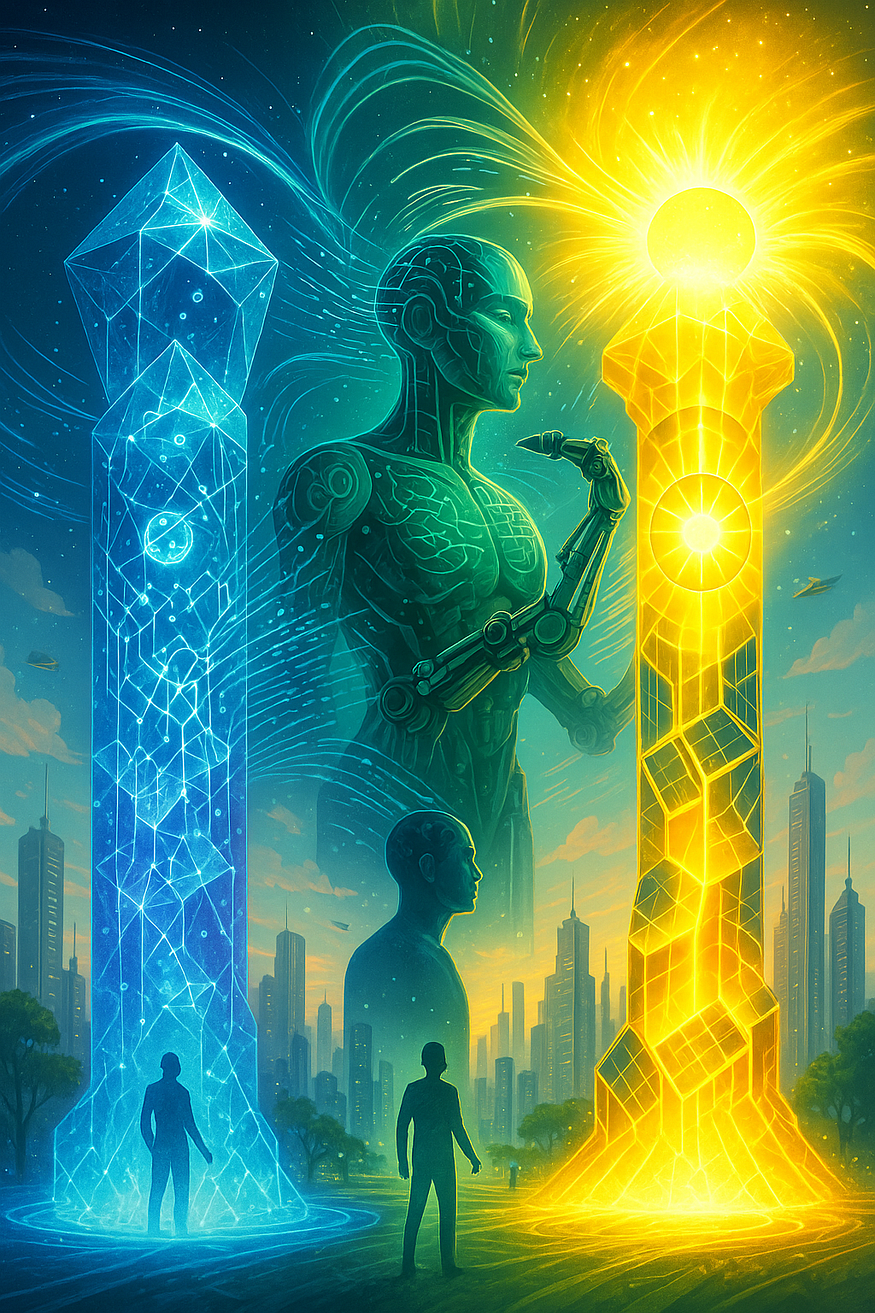
1. Quantum Computing: Unlocking Infinite Computational Power
Quantum computing harnesses the strange properties of quantum mechanics, using qubits instead of traditional bits to process information. Unlike classical computers that process data as either 0 or 1, qubits can exist in multiple states simultaneously, enabling exponential increases in processing power and storage capabilities.
The signs of quantum’s emergence are everywhere. Researchers are making breakthrough advances in Majorana fermions — exotic particles that could serve as building blocks for ultra-stable qubits. Photonic quantum memories are enabling the storage and manipulation of quantum information using light particles. Perhaps most remarkably, scientists are developing nanoscale qubit storage systems that could pack enormous computational power into impossibly small spaces.
The potential is staggering. Quantum computers could crack encryption systems that protect our digital world today, while simultaneously creating new, unbreakable quantum encryption methods. They could simulate molecular interactions with perfect accuracy, revolutionizing drug discovery and materials science. Complex optimization problems that stump today’s computers — from traffic flow in megacities to supply chain logistics across continents — would become trivial to solve.
Yet significant challenges remain. Quantum decoherence — the tendency for qubits to lose their quantum properties when disturbed by the environment — continues to plague researchers. Scaling quantum systems from laboratory prototypes to industrial-grade machines remains extraordinarily difficult and expensive. Current quantum computers require near-absolute-zero temperatures and isolation from any vibration or electromagnetic interference.
The future vision is breathtaking: a quantum-powered world where scientific simulations that would take millennia on classical computers complete in hours, where artificial intelligence systems tap into quantum processing to achieve unprecedented capabilities, and where vast amounts of data are stored in devices smaller than a grain of sand.
2. AI: The Digital and Physical Intelligence Revolution
Artificial Intelligence is evolving along two parallel tracks that are beginning to merge. Digital AI focuses on software-based automation, analysis, and innovation, while Physical AI brings intelligence into the tangible world through adaptive, learning robots and autonomous systems.
The current signs are remarkable and sometimes startling. Swan.ai, a company with just three employees, has achieved $30 million in annual recurring revenue by leveraging AI to automate complex business processes. Tesla’s humanoid robots are learning to perform intricate manufacturing tasks by observing human workers, demonstrating how Physical AI can acquire skills through observation rather than explicit programming.
The transformative potential spans every industry imaginable. Digital AI is already revolutionizing software development, scientific research, creative industries, and business operations. Physical AI promises to transform manufacturing, healthcare, transportation, and domestic life through robots that don’t just follow commands but learn, adapt, and make intelligent decisions in real-time.
However, this power comes with profound challenges. Ethical concerns about AI decision-making, particularly in critical areas like healthcare, criminal justice, and financial services, remain largely unresolved. Data privacy issues multiply as AI systems require vast amounts of personal information to function effectively. Safety concerns about autonomous systems — from self-driving cars to surgical robots — demand unprecedented levels of reliability and fail-safe mechanisms.
The future vision is one where AI democratizes innovation, enabling anyone with an idea to build sophisticated software solutions without coding expertise. Physical AI robots become versatile partners in workplaces and homes, handling dangerous, repetitive, or physically demanding tasks while humans focus on creative, strategic, and interpersonal work.
3. Infinite Green Energy: Powering the Future Sustainably
The third pillar encompasses a constellation of clean energy technologies: nuclear fusion, advanced renewable systems (tapping into solar), and small modular reactors (SMRs) that promise abundant, sustainable power for humanity’s growing energy needs.
Current progress is accelerating rapidly. The ITER fusion project continues making strides toward sustained fusion reactions, while private companies like Commonwealth Fusion Systems are developing compact fusion reactors that could be commercially viable within the next decade. Small modular reactors from companies like NuScale are beginning deployment, offering safer, more flexible nuclear power that can be installed closer to population centers.
The potential is transformative. Fusion energy could provide virtually limitless power with no carbon emissions and minimal radioactive waste. Advanced renewable systems, optimized by AI and supported by quantum-enhanced materials, could achieve unprecedented efficiency levels. SMRs could provide clean baseload power for data centers, cities, and industrial operations without the massive infrastructure requirements of traditional nuclear plants.
The challenges are substantial but not insurmountable. Fusion remains extremely expensive and technically complex, with commercial viability still years away. Regulatory frameworks for new nuclear technologies move slowly, potentially delaying deployment. Scaling these technologies to meet global energy demands will require unprecedented international cooperation and investment.
The future vision is a world where energy scarcity becomes a historical footnote. Cities powered entirely by clean energy, massive data centers running AI and quantum systems without environmental guilt and developing nations leapfrogging fossil fuel infrastructure directly to unlimited clean power.
The Convergence: When Pillars Become Pyramids
The true magic happens when these three pillars converge and amplify each other’s capabilities. Quantum computing enhances AI processing power and optimizes energy systems for maximum efficiency. AI manages quantum systems, maintaining coherence and optimizing performance while designing better energy solutions. Infinite green energy powers both quantum computers and AI systems without environmental compromise.
Consider quantum-enhanced AI systems designing fusion reactor configurations, testing millions of magnetic field arrangements in simulation before building physical prototypes. Imagine AI-driven smart grids that use quantum optimization to balance energy supply and demand across entire continents in real-time. Picture quantum computers powered by fusion energy solving climate modeling problems that help us reverse environmental damage.
This creates a self-reinforcing cycle of innovation where each advancement accelerates progress in the other domains, creating exponential rather than linear technological growth.
Real-World Applications: The Future Taking Shape
The convergence of these technologies will create applications that seem almost magical today:
Personalized Medicine at Scale will use quantum-AI systems to analyze genomic and real-time health data, creating tailored treatments and predicting diseases before symptoms appear. AI-driven surgical robots will deliver precision therapies, all powered by clean fusion energy. This could save millions of lives while reducing healthcare costs and democratizing access to advanced care.
Functionally Sentient AI Companions with human-like emotional intelligence will serve as personal assistants, therapists, and educators. Using quantum storage for vast contextual memory and powered by green energy, these systems will enhance mental health, education, and productivity while creating entirely new trillion-dollar markets.
Zero-Carbon Smart Cities will use AI to optimize urban systems — traffic flow, waste management, energy distribution — powered entirely by fusion or SMRs. Quantum computing will model climate impacts for real-time adaptation, potentially reducing global emissions while improving quality of life for billions.
Ultra-Fast Drug Discovery will leverage quantum computing to simulate molecular interactions at unprecedented speeds while AI designs novel therapeutic compounds. Green energy will power massive computational laboratories, slashing drug development timelines and potentially delivering cures for cancer, Alzheimer’s, and rare diseases.
Autonomous Industrial Ecosystems will feature physical AI robots managing factories, mining operations, and agricultural systems with minimal human oversight. Quantum optimization will handle logistics while fusion power enables sustainable operations, potentially boosting global GDP while addressing labor shortages and enhancing food security.
Challenges and Responsibilities: Navigating the Transformation
The path forward isn’t without obstacles. Technical hurdles remain significant — quantum systems still struggle with stability and error rates, AI reliability in critical applications needs improvement, and energy technologies must scale from prototypes to global deployment.
Ethical issues demand careful consideration. How do we ensure equitable access to these transformative technologies? How do we address AI ethics and the potential for technological unemployment? What environmental considerations accompany the massive infrastructure changes required?
Perhaps most importantly, global cooperation will be essential. These technologies are too powerful and too important for any single nation or corporation to control. International frameworks for development, deployment, and governance will determine whether these tools serve all humanity or exacerbate existing inequalities.
Conclusion: Standing at the Threshold
Quantum Computing, AI, and Infinite Green Energy represent more than technological advances — they’re the foundation stones of a fundamentally different future. Together, they promise unparalleled computational power, unprecedented intelligence, and sustainable energy that could power human civilization for millennia.
We stand at a unique moment in history where science fiction is becoming science fact. The decisions we make in the next decade about how to develop, deploy, and govern these technologies will shape the trajectory of human civilization for generations to come.
The question isn’t whether this future will arrive — the signs are too clear, the progress too rapid, the potential too compelling. The question is how we’ll shape this era of limitless possibilities to serve humanity’s highest aspirations while avoiding its greatest risks.
What Will Humans Do in This World?
As these three pillars reshape civilization, perhaps the most profound question isn’t what these technologies can do, but what humans will do in a world where machines handle most routine tasks, energy is abundant, and computational power is virtually unlimited.
The human role will fundamentally shift from task execution to purpose creation. As AI automates industries from manufacturing to data analysis, and universal education platforms powered by quantum-AI tutors empower billions with personalized learning, humans will migrate toward uniquely human capabilities: creativity, emotional intelligence, strategic thinking, and meaning-making.
In this transformed landscape, lifelong learning becomes not just possible but essential. Freed from the constraints of traditional career paths, people will pursue multiple interests simultaneously — combining arts with sciences, exploring interdisciplinary innovations, or diving deep into philosophical questions that have puzzled humanity for millennia. Who knows, the humans of then will truly start to be explorers and seekers — from planetary civilization to inter-planetary and perhaps inter-galactic.
Human-AI collaboration will define many roles. Rather than competing with sentient-like AI companions, humans will work alongside them as creative partners. An architect might collaborate with AI to design structures that seamlessly integrate with quantum-optimized smart cities. A scientist could partner with AI to formulate hypotheses that quantum computers then test through molecular simulations. Artists might co-create with AI systems that understand not just technique but emotional resonance.
Governance and ethics will become increasingly human-centric roles. As these powerful technologies permeate every aspect of society, humans must serve as guardians, ensuring ethical development and equitable access. This isn’t just about regulation — it’s about stewarding technologies that could either liberate humanity or create new forms of inequality and dependence.
Perhaps most importantly, humans will grapple with profound questions of identity and purpose in a post-scarcity world. When basic needs are met through abundant clean energy and AI-optimized systems, when physical labor is handled by adaptive robots, and when cognitive tasks are augmented by quantum-enhanced AI, what defines human value and meaning?
The answer may lie in our uniquely human capacity for connection, empathy, and the search for transcendent purpose. Community building, spiritual exploration, artistic expression, and the cultivation of wisdom rather than just intelligence could become humanity’s primary pursuits.
Some will choose to push the boundaries of human experience — exploring space, diving into ocean depths, or expanding consciousness through new forms of technology-assisted meditation and self-discovery. Others might focus on preserving and reinterpreting human culture, ensuring that our stories, values, and hard-won wisdom aren’t lost in the rush toward technological advancement.
The greatest challenge won’t be technological but existential: finding meaning when survival is guaranteed. This is both humanity’s greatest opportunity and its most daunting test. Will we use this freedom to become more fully human, or will we lose ourselves in the comfort of a world where machines handle everything?
The answer will shape not just our future, but our fundamental understanding of what it means to be human in an age of limitless technological possibility.
— — — — — — — — — — — — — — — — — — — — — — — — — — — — —
What role do you want to play in this transformation? How do you envision these technologies changing your industry, your community, your daily life? More importantly, what uniquely human contributions do you want to make in a world where machines can do almost everything?
Share your vision for how quantum computing, AI, and infinite green energy could solve problems you care about or unlock opportunities you dream of. But also consider: What will give your life meaning when the traditional markers of success — scarcity, competition for resources, and the need for routine labor — no longer apply?
The conversation about our technological future belongs to all of us, because ultimately, that future belongs to all of us too. The question isn’t just what we can build, but who we choose to become.
Credits: Collaborative (brainstorming) effort of Dhilip Narayan Srinivasan, Grok by xAI and Claude.ai by Anthropic. Image Courtesy: ChatGPT by OpenAI

Leave a comment